Ghost Helimed Helicopters — What's Going On?
Ghost helimed helicopters, what’s going on?
Jan 14th 2026A little over one year ago, a new feature was added to the app: Major Incident alerts. Naturally, whenever a helimed helicopter is dispatched, a serious incident is taking place. Something that requires more urgency than a regular, ground-based ambulance crew can provide. These dispatches happen multiple times a day.
On rarer occasions, however, more than one helimed is dispatched to the same incident. When this happens, AirAssist can trigger a Major Incident alert. A good example is January 1st of last year, when multiple Rega, Air Zermatt, and Air-Glaciers helicopters responded to the tragic incident in Crans-Montana.
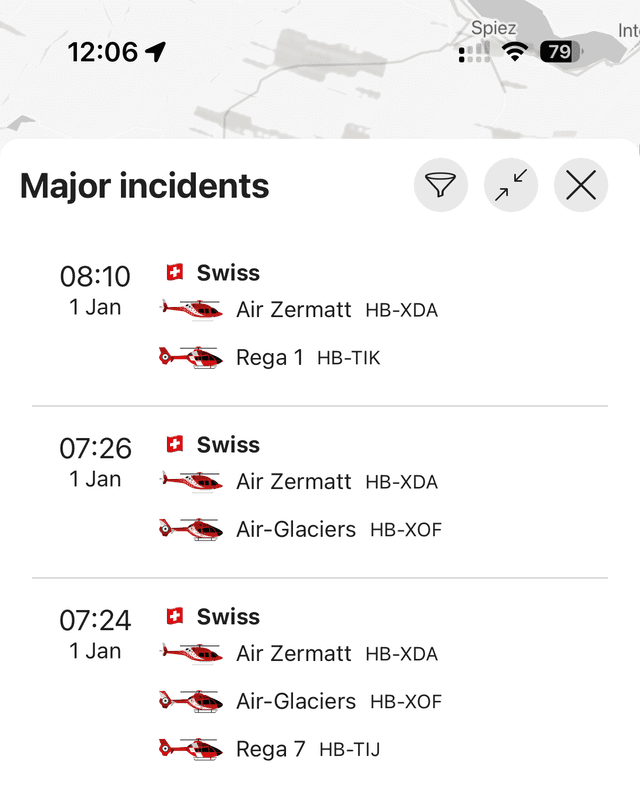
To be able to identify these incidents, the app has to get a bit creative. There is no publicly available information about helimed dispatches. Well, with one exception: in The Netherlands there is a dedicated system called P2000, but this is unique to that country.
Instead, the app looks at how many helicopters have landed within a certain time window and within close proximity of one another. If that number exceeds a predefined threshold, a Major Incident is registered and alerts are sent to users.
The real challenge here is keeping the number of false positives as low as possible.
The first hurdle in preventing false positives is maintaining a comprehensive list of airbases, hospitals, and known landing sites. If a potential Major Incident occurs too close to one of these known locations, the app should ignore it. This is also why the feature isn’t available in all supported countries yet. I simply need more reliable data on active airbases.
After launching the feature, the first reports of false positives started coming in. Sometimes it was due to an airbase that wasn’t yet in my dataset, or an airport so large that my thresholds didn’t properly account for it (looking at you, Heathrow Airport).
But then a report came in that was less straightforward. A Major Incident was detected involving a helicopter that supposedly was present at the site, except it wasn’t. The aircraft hadn’t flown at all; it was in maintenance.
I quickly checked the app, and according to the data, both helicopters were still at the site. So I enabled takeoff notifications for both of them. A few minutes later, they were airborne... both of them. Side by side:
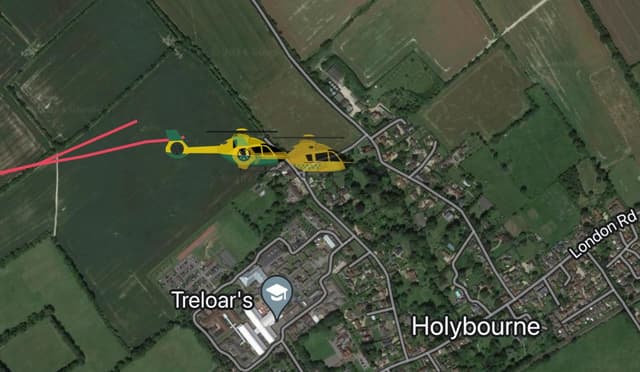
I checked multiple independent sources (other ADS-B–based tracking providers) and all of them showed the same thing: two helicopters flying side by side.
So what is going on?
This part took quite some time to figure out. I reached out to several different sources, but while many promised to investigate, none of them ever followed up.
Eventually, I received a crucial tip. In addition to the EC135’s built-in Garmin ADS-B transponder, some UK helimed crews also carry a SkyEcho ADS-B backup transponder. When both the Garmin and SkyEcho are configured with the same Mode-S ICAO code you get noise in the data. This noise is usually filtered out by receiving systems. However, if the SkyEcho is configured with the Mode-S code of a different aircraft, it creates exactly the kind of duplicate “ghost” aircraft we’re seeing in the data.
Just this week, I was notified of a similar scenario. This time, the “ghost” helicopter wasn’t in maintenance but flying elsewhere in the UK. It appears the pilot may have taken the SkyEcho into a different aircraft, once again introducing noise into the data. In other words, it seems to come down to human error.
This leaves one remaining question: why do UK helimed crews carry SkyEcho devices in the first place? I haven’t encountered this practice in other countries. If you know the answer, please reach out!
It’s also worth noting that the SkyEcho user manual explicitly states that the device should be turned off when another ADS-B Out transponding system is already on board. That makes me even more curious why these units are active at all.